Wolf Oven Repair
Wolf Oven Not Holding Temperature: Sensor or Calibration?
An oven that reads 350°F and bakes like 300°F is usually one of three things. How to tell a drifted sensor from a wrong offset from a heat source that is failing, and why calibration comes last, not first.
Rafael Monteiro Cooking-appliance technician — ventilation and blowers · 9 years in the trade
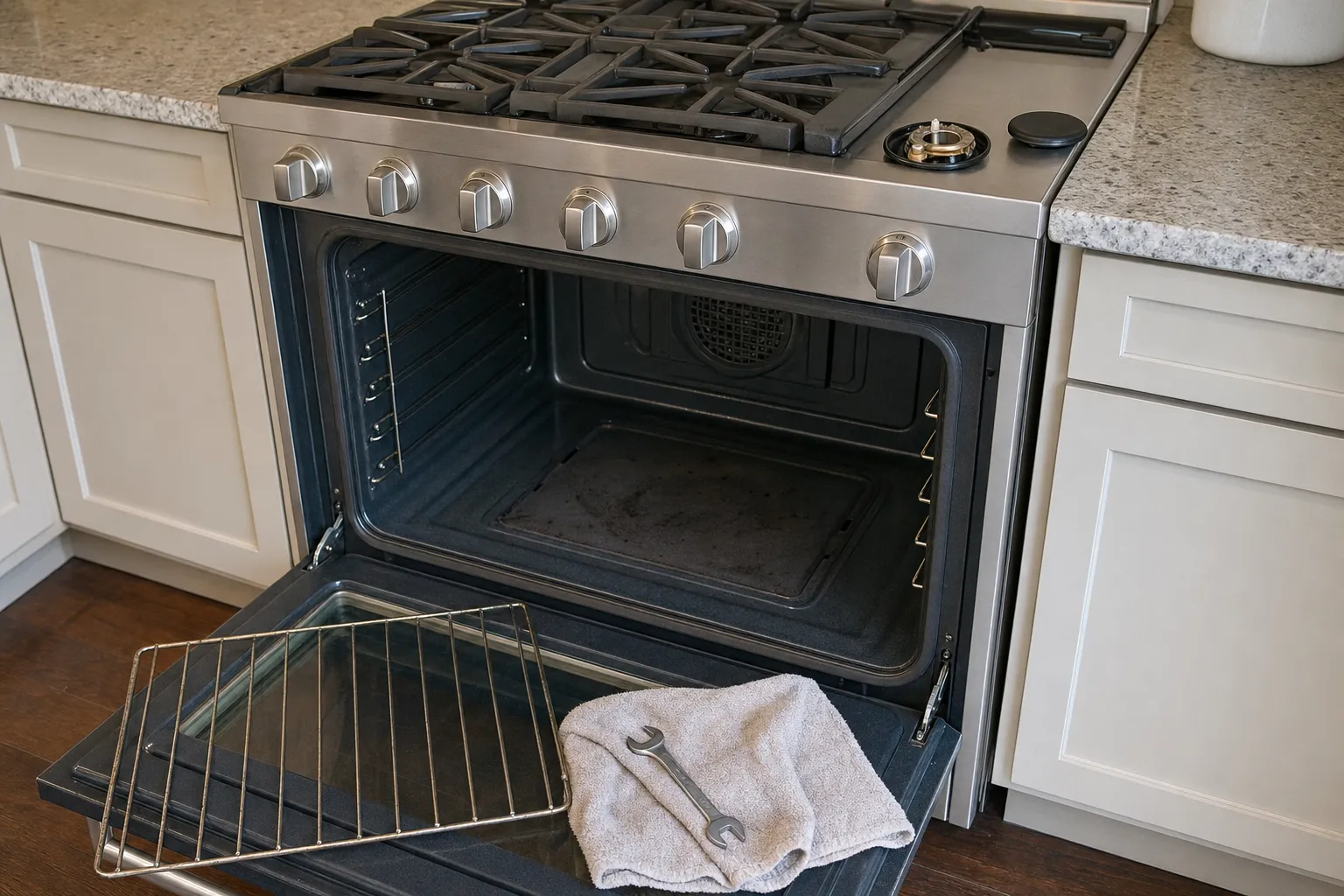
“The oven says 350 and it bakes like 300.” We hear that sentence most weeks, and it is a good description of a real fault rather than a vague complaint. A Wolf oven that cannot hold its set point is doing one of three things: reading the cavity incorrectly, being told to aim at the wrong number, or failing to produce the heat it is asking for. They feel identical from the kitchen and they are easy to separate with a probe.
First, prove the problem exists
Before anything is opened, establish the actual offset. Hang an independent oven thermometer in the centre of the middle rack, dial in 350°F and let the cavity call its own preheat. Then wait another fifteen minutes — the tone fires when the air reaches temperature, not when the cavity walls and racks have caught up, and reading it too early is the single most common source of false alarms.
Write down the reading at fifteen minutes, thirty minutes and forty-five minutes. What you are looking for is the pattern, not one number:
- Steady and low, every reading. A consistent offset: a drifted sensor, or an adjustment that no longer suits the oven.
- Swinging wildly between readings. A control or heat-source problem, not an offset.
- Climbs, then falls away and never recovers. The heat is being lost. On a dual fuel range that means the bake element or the control switching it; on an all-gas range, a burner losing its flame.
- Correct on bake, wrong on convection. The convection side, with the bake side healthy.
That exercise decides everything that follows.
Rule out the simple things
Wolf’s own first checks come before anyone talks about calibration, and they are all things you can look at: the right cooking mode for the dish, a door that closes fully on a gasket that is not torn, racks seated properly, and nothing blocking the airflow around the cavity. A foil-lined rack or a tray sitting on the floor of the oven changes how it heats more than people expect.
Calibration is a service setting
Wolf’s position is that calibrating an oven is possible but seldom needed, and it treats the adjustment as work for a service technician. On a current dual fuel range the temperature offset sits in the settings under an entry marked for service use only. So it is not the first move, and it is not an owner’s fix.
It also must not be used to mask a fault. If the error is large, or it changes depending on how long the oven has been running, or the cavity takes an age to preheat, an offset simply hides a failing component for a few weeks until it fails properly. We measure first, and only a sound oven with a small, steady error gets an adjustment.
Testing the oven sensor
The oven temperature sensor is a probe in the cavity whose electrical resistance rises predictably with heat. The control converts that resistance into a reading, so a sensor that has drifted makes the control confidently wrong: the display agrees with the dial while the food disagrees.
We test it with a meter against the figure that sensor ought to show at room temperature, and look at the probe itself, since one knocked out of position by a roasting pan is reading the wrong spot. A sensor is changed only after that test, so a good part is never swapped while the real fault stays in place. Wolf’s guide asks owners not to repair or replace parts themselves, and this is one to leave to us.
Elements, ignition and the dual fuel difference
The two kinds of Wolf range fail differently here, because their ovens are heated differently.
Dual fuel means gas at the cooktop and electric heat in the cavity below. When that oven cannot reach temperature at all, the bake element is the first suspect: one that has failed open produces no heat while the fan runs and the display behaves perfectly, which is why people so often assume the board has gone. A blister or break in the sheath is sometimes visible; a meter settles it. Less often a relay on the dual fuel control board welds or stops closing, and that is the one case where the board genuinely is the answer.
An all-gas range lights its oven burner with a spark, not a glowing igniter. The igniter clicks while the control waits for flame; if none is sensed within about seven seconds, the oven clears the gas for 40 seconds and tries again, and two misses end in a safety lock-out with a slowly flashing light. An all-gas oven that heats slowly, or gives up part-way through a bake, may be losing its flame — and the first thing Wolf asks is whether the convection fan was on during preheat, because the moving air can pull the flame away from the igniter.
When it is worth calling someone out
Start with the thermometer check: it costs nothing, and it tells you which conversation you are having. If it shows only the normal swing around the setting, nothing needs doing. If it shows a steady error, that is a sensor test first and, only if the sensor is sound, an adjustment made as a service setting.
Call if the oven will not reach temperature at all, if the swing is wild, if an all-gas oven locks out with a slowly flashing light, if there is a burning-electrical smell, or if a fault code appears on a dual fuel display and returns after the power has been off and on. Those need a meter across a sensor and an element, and a look at what the control is actually commanding — not another guess and another part.
Common follow-ups
How much temperature swing is normal in a Wolf oven?
Some swing is built in. The oven switches its heat on and off to hold an average, so a thermometer will read a little above and then a little below the setting over a bake. What is not normal is a steady error, where the average itself sits well away from the number you set, bake after bake.
Will an oven thermometer from the supermarket tell me enough?
It will tell you whether there is a problem, which is the useful part. Hang it in the centre of the middle rack, preheat fully, and give it a further fifteen minutes to settle. Do not trust the reading in the first two minutes after the preheat tone, and do not read it through the door glass.
Does a self-clean cycle damage the oven?
It does not damage a healthy oven, but it is a stress test that finds anything already marginal. Thermal fuses, door latch motors and tired bake elements very often fail during or just after a self-clean, which is why a cycle run the week before Thanksgiving is a genuinely bad idea.